Showing posts with label CO2. Show all posts

Cycling needs infrastructure built for cycling.

As I have posted before, we have a government promising significant modal shift to walking to cycling for doing almost nothing to make it happen, even when spending hundreds of millions on major roads.  

At most we seem to get some shared path signs on existing pavements - which no-one supports as good practise - or dotted white lines on roads.

Rachel Aldred researched the views of people on different types of infrastructure.   While the majority of respondaent were regular cyclists, they were not only asked whether they would use teh various types of infrastructure, but whether others would.  The results are not exactly surprising - but they give a clear indication.

Cycling needs infrastructure built for cycling
Not infrastructure designed for motor vehicles. 
Not infrastructure designed for walking. 
But for cyclists:  8 to 80 cyclists 
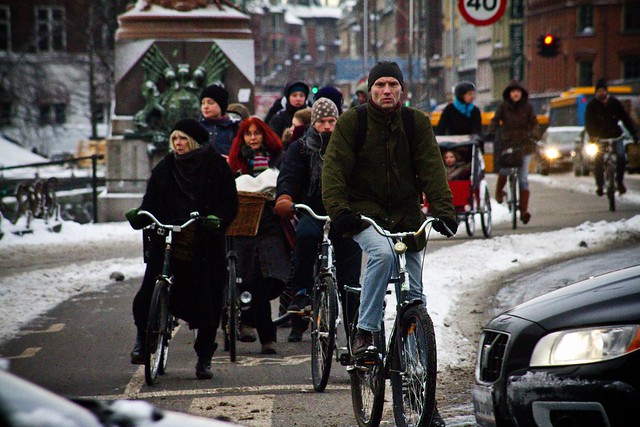

Winter cycling in Copenhagen - along a separated cycle lane.
People supported substantial separation from motor traffic, in various forms. Separation by kerb or by car parking was very popular, as were park routes and streets closed to through motor traffic.

Separation by white lines was not popular - especially for people with children, children on their own or older (perhaps wobbly) cyclists,

Change is partly a matter of will - but also a matter of money.  And commiting money is the clearest indication of will available.

So if you meet and candidates for Westminster or Holyrood, perhaps you'd like to ask them when they are going to match Dutch levels of per capita spend on cycling.

See Rachel's blog at http://rachelaldred.org/research/children-and-cycling/ complete with a link to her first publication from her research. 

Fuel poverty

With increasing fuel prices, we also see rising fuel poverty which is defined as needing to spend more than 10% income on fuel.  Now fuel prices regardless of source are set to continue to rise and the rate of rise is likely to be faster than any rise in income.

We have to move to having better insulated homes that require minimal heating.    Aberdeenshire has been given £170,000 to bring 20 houses up to the 2016 building standards. That works out at £8,500 a home.  That is a start but with over 100,000 houses in Aberdeenshire it is a drop in an ocean. We know what needs to be done - there is oodles of advice out there.

The problem is up front cost versus cost reduction later.  We need a scheme where homes can be upgraded and the reduction in fuel costs is shared between paying back the cost and providing benefit to the household.

There is a win win win available.
  • We can remove fuel poverty.
  • We can reduce CO2 emissions.
  • And we can have more comfortable homes.
When are we going to stop having "pilot" and "demonstrator" schemes and actually put in place something that will actually make an impact!

Latest climate change research

Super article by the Rob Edwards on the latest climate change research and what may happen at
http://www.robedwards.com/2009/03/climate-catastrophe-beckons-unless-world-agrees-pollution-cuts.html
"All the current promises to cut greenhouse gas emissions will still see global temperatures rise by an average of four degrees centigrade by the end of the century, they say. This is hot enough to make most of the world uninhabitable, killing or making refugees of billions of people in Asia, Africa and America."
Do read the full article.

Earth (2) Hour

We went the whole hog and switched off all the power to the house. This left us with two candles and logs burning on our stove.

Delightful - so Earth Hour extended into nearly two.

So why was this so good?

We stopped and talked.

The light levels went to those we know and love when bothying (see www.mountainbothies.org.uk). But more than that, we felt that we had everything important. And talked about a simpler life.

What matters? - Shelter. People. Warmth - physical and emotional.

We hope to "Earth Hour" more often.

Idealistic? Self indulgent when we can and do switch it all back on?

But worth doing to make us think about what we need rather than want. And to reassess what we do really need.

So we'll do our own personal earth hour more than once a year. And think about what we need - and what the cost of that really is.

Just how serious is Climate Change. ... or should that be catastrophe?

It takes a while for politicians to catch up with science. And maybe we are too late to avert climate catastrophe (see http://www.guardian.co.uk/commentisfree/2009/mar/12/climate-change-copenhagen-monbiot

Now the Maldives, most of which is just 1.5m above sea level have announced that they plan (that's plan not aim) to be carbon neutral in just 10 years.

OK, they have a great incentive to make progress on this. There is a real risk that their country will no longer exist by the end of the century if the worst predictions come true.

But the cost for the package of low-carbon measures is estimated to be about $110m a year for 10 years. The scheme should pay for itself quite quickly, because the Maldives will no longer need to import oil products for electricity generation, transport and other functions. If the oil price were to rise to $100 per barrel, the payback period would be as short as 11 years. At current prices, it would take roughly twice as long to break even.

President of the Maldives, Mohamed Nasheed said: "Climate change is a global emergency. The world is in danger of going into cardiac arrest, yet we behave as if we've caught a common cold. Today, the Maldives has announced plans to become the world's most eco-friendly country. I can only hope other nations follow suit."

See full story at http://www.guardian.co.uk/environment/2009/mar/15/maldives-president-nasheed-carbon-neutral

50 mph

On a holiday in Norway some years ago, I found driving at the national speed limit of 50mph very relaxing. Everyone simply obeyed the limit and apart from the slight jostle to be the first in the line off a ferry, it was very relaxing. Almost no overtaking - all the traffic simply drove at 50mph.

And then there is fuel consumption. Of course this varies with cars, driving style, etc but generally 45-50mph will be the most efficient. Typically driving at 60mph will use 21% more fuel than driving at 60mph.

So, I welcome the government's consultation on reducing the national speed limit to 50mph for single carriageway roads.

Let's say yes to reduce rural road deaths and CO2 emissions.

Washing machines

My washing machine is broken - it's the pump that empties the water. It's 15 years old so I've bought a new one. The ratings for energy efficiency are a bit odd.

I've gone for an A+AA machine and the manufacturer tells me that the energy consumption is 1.02 kwh/cycle and Water consumption is 45 litres/cycle-wash.

But I've seen an AAC machine that quotes 49 litres normal water consumption for a 60 degree wash and 0.95kW energy consumption per cycle.

Both machines take a 6kg load.

So have I been suckered by the labelling?